|
|
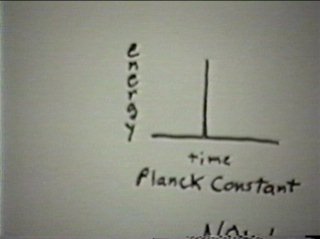
I have read that the Planck constant has the dimensions of energy x time. I have also read that the Planck constant is the energy of action for a particle. Now, as it turns out, I'm an electronics technician, and I frequently use a device which displays electrical signals and plots them on a grid which displays the properties of the signal in the dimensions of energy x time. Its called an oscilloscope. Time is plotted horizontally, and energy is plotted vertically. I have taken the liberty of plotting the dimensions of the Planck constant as an impulse wave in the time-like dimension. The amplitude of the impulse represents the energy available, and the width of the pulse is representative of the duration of the impulse as it travels past a fixed point in the time-like dimension. On either side of this impulse of energy the manifold is static, but in the region defined by the impulse, the manifold is dynamic. The energy of the impulse is applied to altering the manifold to include it, so it represents a dynamic region where the pre-existing structure of "future" space-time is being modified to incorporate additional energy. We live on this thin dividing line between past and future. All physical interactions in the observable universe occur on this thin dividing line between past and future. Any physical interaction which does not occur on this thin dividing line between past and future cannot be observed by us, because it is not mediated in the present. Quantum physicists have been asking for decades, "where does the quantum wave function collapse?" I have the answer. It collapses here, now, on the dividing line between past and future, because "now" is a valid location in space-time. Since it is always now, the quantum wave function is always in the collapsed state. Reality is always actualized now, on this dividing line between past and future, and the Planck constant is always found in every situation in which an interaction occurs, because in your equations, the Planck constant is a direct reference to the phenomenon of the present, "now." It is terribly inconvenient to keep typing out the "phenomenon of the present," so in my own cosmology notes I refer to this as the "delta wave." |
|
|
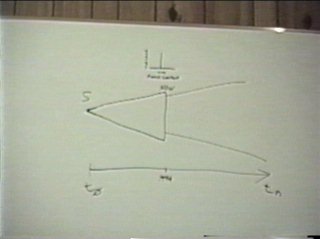
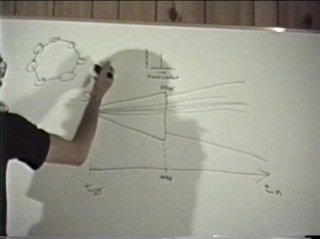
The difference between temporal strings and nuclear strings is highlighted. Nuclear strings are composed of stacked quanta with their momentum vectors and angular momentum vectors aligned. I suspect it is easier for the quanta to navigate through space-time in the stacked configuration, less bookkeeping. If you recall, a quanta is considered a thin slice of a temporal string, the thickness of that slice corresponding to the thickness of the delta wave plotted in the first illustration on this page. A single nuclear string therefore harbors many temporal strings, but only the region of the temporal string which is defined by the delta wave has any potential for interaction that we may observe. Consequently, we see the nuclear strings, but not the temporal strings. (When I say "nuclear strings," I mean all four varieties of string used to structure leptons and hadrons, not just the hadrons.) Temporal strings are a hidden variable, they contribute to the locations of particles in space-time, but the exact nature of their contribution in a specific interaction can not be defined since their locations in space-time cannot be determined by any means available to us. |
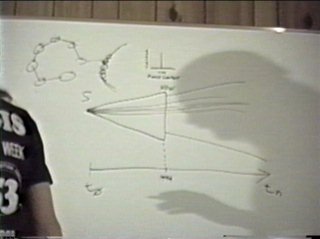
| In the next illustration I am attempting a rather poor explanation of phase entanglement and wave collapse of a photon. In essence, each quanta in a loop of string has the string address of the quanta ahead of it in the string. Classical scattering can occur to the quanta in the loop of string as a result of traveling through the ether, but since only energy-energy interactions involving the mixing of the phases (energy mixing) causes an update to the spreadsheet of the string, the string does not reflect any awareness of the scattering which is occurring to it. Once an energy-energy interaction involving phase mixing does occur with a quanta which is not in the addressing loop of the string, an update to the spreadsheet is triggered. Wherever that interaction occurs, the updating of the spreadsheet re-locates all the quanta in the string to the space-time address where the interaction occurred. I imagine this proceeds linearly through the string, like a domino effect re-addressing each corpuscle as it goes, though I suppose it could also be an instantaneous global function of the spreadsheet. I lean towards the domino effect, though. |
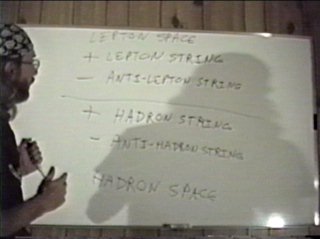 |
The four string types are given in their respective domains. In lepton space, the (+) Lepton String is the primary structural element of leptons. The (-) Anti-lepton string is the primary structural element of anti-leptons. The (+) and (-) refer to the handedness of the string, which also is indicative of the direction their momentum is applied in. In hadron space, the (+) Hadron String is the primary structural element of hadrons, and the (-) Anti-Hadron String is the primary structural element of anti-hadrons. |
Note that pinning a hadron string to a lepton will increase its gravitational interaction in hadron space, giving the lepton a much larger apparent mass. The hadron string in the bound state becomes a part of the particle spreadsheet for the lepton, and may actually require gravitational radiation in hadron space to support it, at least until the lepton can shed it for a lepton string, or decay. I believe the muon is an electron which has pinned a (radical) hadron string in place of its usual (orphan) lepton string. If the model holds up, hadrons with pinned lepton strings should also generate a small amount of gravitational radiation in lepton space. (The muon in lepton space would be an exact mirror symmetry of the proton in hadron space.) Most particles participate at the quark level in generating both positive and negative charge currents, and so will likely generate a semblance of mass in both domains, however there seems to be a significant disparity between the two domains in the treatment of gravitational mass. Hadron strings seem to require a great deal more energy to administer the charge force in hadron space than leptons do in lepton space. I speculate it is due to a difference in energy-density between the two space-time domains, but that is not the only possible explanation. Lepton strings just may be more efficient somehow. I theorize that gravitational radiation is permitted by the point interfacing of lepton and hadron space in down quarks and bogus down quarks, and I believe the down quarks are the source of all corpuscular gravitational radiation. (2008 NOTE: There is a more recent discussion of particle mass on the String Basics page.)